Pharma & Life Science

Pharmacovigilance

Protect Patient Safety Through Drug Safety Monitoring

Learn the fundamentals of Pharmacovigilance (PV) and understand how medicines are monitored for safety throughout their lifecycle.

Explore adverse events, Individual Case Safety Reports (ICSRs), case processing, seriousness, expectedness, causality, MedDRA concepts, signal detection, aggregate safety reports, regulatory concepts, and safety reporting workflows through practical case-based exercises.

Pharmacovigilance

ConsivoX Certified

16 Modules • Live Mentorship

Course Highlights

Duration

16 – 32 Hours

Learning Tracks

Foundation • Professional • Advanced

Level

Beginner to Advanced

Curriculum Scope

16 Modules • Live Mentorship

Practical Focus

Hands-On Case Studies & Labs

Hands-On

Live & Capstone Development

Outcome

Real-World Production Projects

Credential

Certificate of Completion

Core Outcomes

What You'll Learn

Key Competencies
Pharmacovigilance fundamentals
Drug safety and patient safety concepts
Adverse Events and Adverse Drug Reactions
Individual Case Safety Reports
ICSR case processing workflow
Minimum criteria for a valid safety case

Why Learn Pharmacovigilance?

Pharmacovigilance plays an important role in identifying, evaluating, understanding, and preventing adverse effects and other medicine-related safety problems.

Industry-Aligned Curriculum

Gain practical mastery of Pharmacovigilance concepts matching modern production standards.

Hands-On Project Building

Develop production-grade applications and case studies directly for your professional portfolio.

Career & Interview Readiness

Acquire the technical confidence and problem-solving skills required for high-impact roles.

FLEXIBLE FORMATS

Pharmacovigilance — Modes of Learning

Choose the learning mode that fits your schedule, lifestyle, and career goals with hands-on practice built in.

16 Hours

Foundation

₹5,500 • 16 Hours

Master essential foundations with live instructor-led sessions, 6-month LMS access, and core learning materials.

16+ Hours of Live Instructor-Led Sessions
LMS Access for 6 Months
Course Materials & Learning Resources
Most Popular

Professional

₹7,500 • 24 Hours

Elevate your practical skills with 1:1 doubt clearing sessions, dedicated mentor support, and extended lab work.

24+ Hours of Live Instructor-Led Sessions
One-on-One Doubt Clearing Sessions
LMS Access for 6 Months
Dedicated Mentor Support
Career Track

Advanced

₹9,000 • 32 Hours

Comprehensive career masterclass featuring extensive live sessions, 1:1 mentor syncs, interview prep, and placement guidance.

32+ Hours of Live Instructor-Led Sessions
One-on-One Doubt Clearing Sessions
LMS Access for 6 Months
Dedicated Mentor Support
Placement Guidance
Interview Assistance
STRUCTURED ROADMAP

Pharmacovigilance Curriculum

Step-by-step learning progression designed for practical mastery, from fundamentals to production-ready deployment.

16 Modules16+ Hours Live & Hands-On

Key Concepts Covered:

  • What is Pharmacovigilance?
  • Importance of Drug Safety
  • Objectives of Pharmacovigilance
  • Pre-Marketing vs Post-Marketing Safety
  • Pharmacovigilance Lifecycle

Key Concepts Covered:

  • Adverse Event (AE)
  • Adverse Drug Reaction (ADR)
  • Suspected Adverse Reactions
  • Medication Errors & Special Situations
  • AE vs ADR

Key Concepts Covered:

  • Spontaneous Reports
  • Clinical Trial Safety Data
  • Literature Sources
  • Consumer & Healthcare Professional Reports
  • Post-Marketing Safety Sources

Key Concepts Covered:

  • What is an ICSR?
  • Four Minimum Criteria for a Valid Case
  • Case Identification
  • Case Intake
  • Initial Case Assessment

Key Concepts Covered:

  • Case Receipt & Data Entry
  • Duplicate Case Identification
  • Data Review
  • Case Follow-Up
  • Case Closure Concepts

Key Concepts Covered:

  • Serious vs Non-Serious Cases
  • Seriousness Criteria
  • Severity Assessment
  • Expected vs Unexpected Events
  • Assessment Examples

Key Concepts Covered:

  • What is Causality?
  • Drug-Event Relationship
  • Temporal Relationship
  • Alternative Causes
  • Causality Assessment Approaches

Key Concepts Covered:

  • What is MedDRA?
  • MedDRA Hierarchy
  • System Organ Class
  • Preferred Terms & Lowest Level Terms
  • Medical Coding Concepts

Key Concepts Covered:

  • Purpose of Case Narratives
  • Patient & Event Information
  • Drug & Medical History
  • Clinical Course & Outcome
  • Writing a Clear Safety Narrative

Key Concepts Covered:

  • Pregnancy & Lactation Cases
  • Medication Errors
  • Overdose & Misuse
  • Lack of Efficacy & Other Special Situations
  • Follow-Up Information

Key Concepts Covered:

  • Safety Database Fundamentals
  • Case Entry & Data Fields
  • Workflow & Case Status
  • Quality Review
  • Safety Database Concepts

Key Concepts Covered:

  • What is a Safety Signal?
  • Signal Detection Fundamentals
  • Signal Validation
  • Signal Assessment
  • Signal Management Concepts

Key Concepts Covered:

  • Aggregate Safety Reports
  • Periodic Safety Reporting Concepts
  • Benefit-Risk Assessment
  • Safety Data Analysis
  • Aggregate Report Structure
  • Keep this at conceptual level in a 16-hour course rather than attempting detailed regulatory report preparation.

Key Concepts Covered:

  • Pharmacovigilance Regulatory Framework
  • Regulatory Authorities
  • Expedited Reporting Concepts
  • Reporting Timelines
  • Good Pharmacovigilance Practices

Key Concepts Covered:

  • Case Intake
  • Case Validity Assessment
  • Seriousness & Expectedness
  • MedDRA Coding Concepts
  • Case Narrative & Safety Assessment
  • Project: ICSR Case Processing & Safety Assessment
  • Work through a controlled fictional safety case from initial receipt through assessment and documentation.
  • Project Deliverables
  • Case intake information
  • Patient information
  • Suspect drug information
  • Adverse event information
  • Seriousness assessment
  • Expectedness assessment
  • Causality assessment
  • MedDRA coding exercise
  • Case narrative
  • Follow-up requirements
  • Final case assessment

Key Concepts Covered:

  • End-to-End PV Workflow Review
  • ICSR Case Processing Assessment
  • Pharmacovigilance Documentation
  • Common PV Interview Questions
  • Pharmacovigilance Career Pathways

Everything You Need to Master Pharmacovigilance

Comprehensive technical foundation, modern tooling, and production workflows packed into a focused, hands-on curriculum.

Drug Safety Fundamentals

Master core Pharmacovigilance principles, scalable architectures, and practical techniques.

AE & ADR Concepts

Understand the purpose and importance of Pharmacovigilance and medicine safety monitoring.

ICSR Processing

Learn the difference between adverse events, adverse drug reactions, and other safety information.

Case Assessment

Understand the fundamental workflow for processing individual case safety reports.

MedDRA Concepts

Practice evaluating important case characteristics such as seriousness, severity, expectedness, and causality.

Case Narrative Writing

Understand standardized medical terminology and the MedDRA hierarchy used for safety data coding.

Real-World Projects You'll Build

Build production-grade applications that demonstrate your skills to engineering recruiters and hiring managers.

Capstone SpotlightPharma & Life Science Project

Adverse Event Case Assessment

Build

Key Features:

  • Analyze a fictional adverse event report and identify the relevant safety information.
  • Identify patient information
  • Identify suspect product
  • Identify adverse event
  • Review clinical information
  • Assess case completeness
PharmacovigilanceConsivoXPortfolio
Production Ready
Project 02Pharma & Life Science Project

ICSR Case Processing

Build

Key Features:

  • Process a fictional Individual Case Safety Report through a simplified pharmacovigilance workflow.
  • Case intake
  • Valid case assessment
  • Duplicate check exercise
  • Seriousness assessment
  • Expectedness assessment
  • Follow-up identification
PharmacovigilanceConsivoXPortfolio
Production Ready
Project 03Pharma & Life Science Project

MedDRA Coding & Case Narrative

Build

Key Features:

  • Convert fictional medical event information into a structured safety case.
  • Identify medical concepts
  • MedDRA coding exercise
  • Review patient history
  • Organize clinical information
  • Prepare case narrative
PharmacovigilanceConsivoXPortfolio
Production Ready
Project 04Pharma & Life Science Project

Complete Pharmacovigilance Case Study

Build

Key Features:

  • Perform an end-to-end assessment of a fictional safety case.
  • Case intake
  • ICSR validity
  • Patient/product/event assessment
  • Seriousness
  • Severity
  • Expectedness
  • Causality
  • MedDRA coding
  • Case narrative
  • Follow-up assessment
  • Final safety assessment
PharmacovigilanceConsivoXPortfolio
Production Ready
OFFICIAL CREDENTIALS

Government Recognized Industry Certification

Earn authentic, verifiable credentials recognized by industry leaders and verified via Startup India, MSME, and the Ministry of Corporate Affairs.

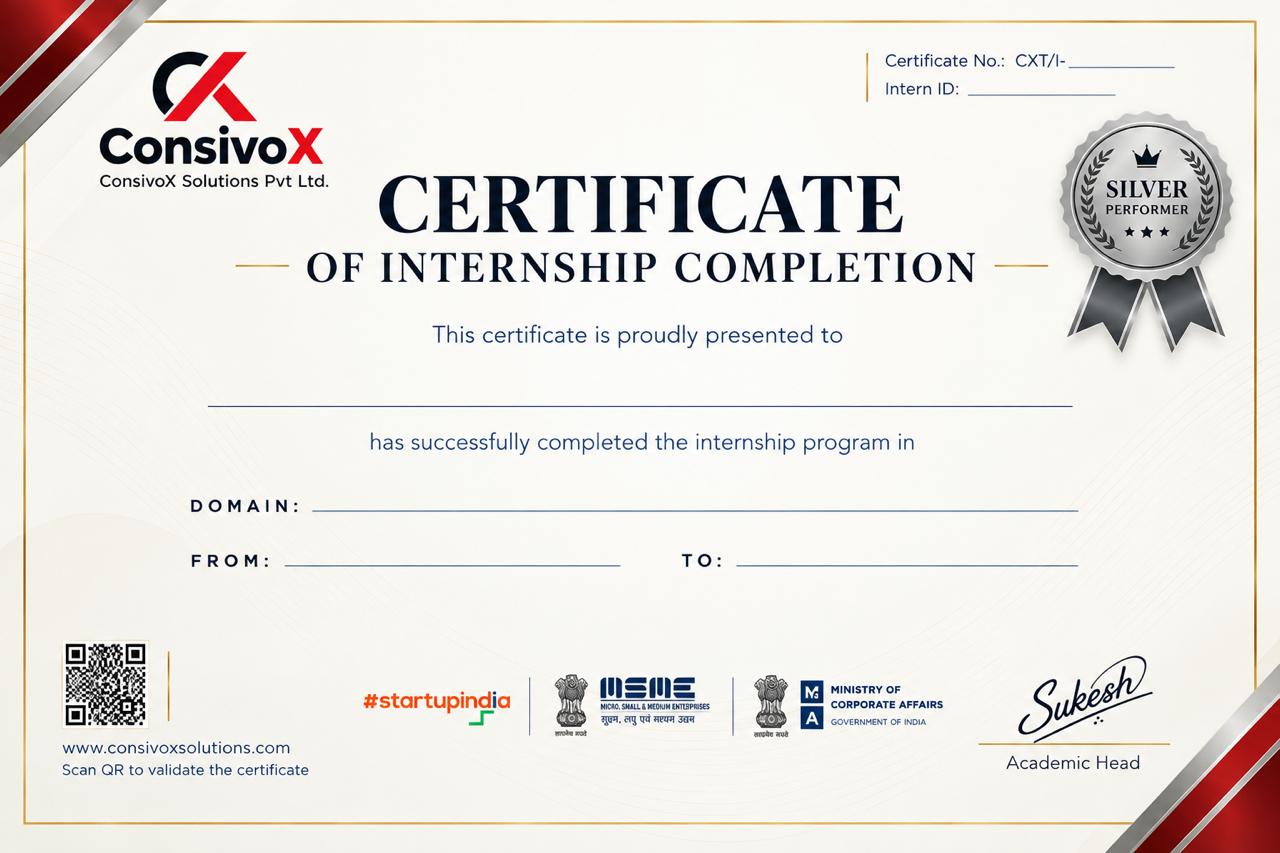
TIER 01 • Silver PerformerSilver Performer

Silver Certificate

Validates core engineering fluency, active internship engagement, and successful project submissions.
100% completion of course modules & domain internship tasks
Practical evaluation across live project milestones
Code submissions reviewed and approved by mentors
Unique QR code verification valid for lifetime authentication
Verified Internship Credential & LinkedIn Badge
Silver Certificate — ConsivoX Solutions
View Full Certificate
Official QR & Govt. AccreditedClick to Enlarge

Government & Corporate Recognition

Accredited under Startup India, MSME, and Ministry of Corporate Affairs.

Verifiable Dynamic QR Code

Instant online validation for recruiters and hiring managers.

LinkedIn One-Click Integration

Seamlessly showcase verified credentials on your professional profile.

Chat on WhatsApp